
Everything You Need to Know About PRP Hair Restoration: A Comprehensive Guide
by: Mila Merenkov
Hair loss can feel frustrating, unpredictable, and deeply personal. Whether you’re noticing gradual thinning, a widening part, or early signs of pattern baldness, finding a solution that actually works without surgery can be challenging. At Allure Med Spa, patients have access to advanced, non-surgical options built to address these concerns with a personalized approach.
One treatment that keeps drawing attention for its natural, regenerative approach is PRP hair restoration. This innovative therapy draws on the body’s own healing properties to stimulate hair growth, build density, and strengthen the follicles that are already there.
In this comprehensive guide, you will learn how PRP works, who it is for, what results to expect, and how it compares to other hair loss treatments.
Introduction to PRP Hair Restoration
Hair loss affects both men and women, across a range of ages. The common causes include genetics, hormonal changes, stress, and lifestyle factors. Traditional treatments like medication and transplants are still popular, but a lot of people are now looking for non-surgical options with little downtime.
Where PRP hair restoration sets itself apart is in regenerating rather than replacing. Rather than adding hair artificially, it goes to work reviving the follicles you already have, drawing on your body’s own biology to do it.
Part of what Allure Med Spa has done is make the treatment more accessible, with personalized, medically guided PRP shaped around each person’s hair loss pattern.
What Is PRP Hair Restoration?
PRP stands for Platelet-Rich Plasma, a component drawn from your own blood.
Blood is made up of:
- Plasma, the liquid portion
- Red blood cells
- White blood cells
- Platelets
Platelets are best known for their role in clotting, but they also carry growth factors that support tissue repair and regeneration.
In PRP hair restoration, those platelets are concentrated and injected into the scalp to:
- Stimulate weakened or dormant hair follicles
- Improve blood supply to the scalp
- Encourage thicker, healthier hair growth
Because PRP uses your own biological material, it tends to be a low-risk treatment.
How PRP Hair Restoration Works
The PRP process is straightforward, and usually done in under 90 minutes. Here is what happens, step by step:
1. Blood Draw
A small blood sample is taken, much like a routine lab test.
2. Centrifugation
The blood goes into a centrifuge, which spins fast to separate its components. That isolates the platelet-rich plasma.
3. Platelet Concentration
The PRP holds a higher concentration of growth factors, often several times what is in normal blood.
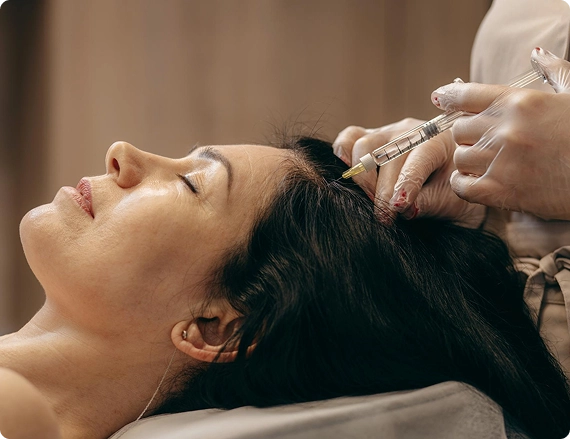
4. Scalp Injections
The PRP is carefully injected into the targeted areas of the scalp with a fine needle.
What Happens Next?
Once injected, the growth factors:
- Stimulate follicle activity
- Extend the hair’s growth phase
- Improve thickness and density over time
The idea is to reawaken underperforming follicles, helping them produce stronger, healthier hair.
Is PRP Hair Restoration Right for You?
There is no one-size-fits-all here, but for a lot of people in the early to moderate stages of hair loss, PRP works well.
Ideal Candidates
- Anyone noticing their hair thinning
- Early-stage pattern baldness, in men or women
- People dealing with stress-related shedding
- Those who want to hold onto the hair they have and slow the loss
Who May Not Benefit as Much
- People with advanced baldness, where no active follicles are left
- Certain medical conditions that affect healing or blood quality
- Severe scalp conditions
The only way to know for sure is a professional consultation, where a provider can work out whether PRP fits your particular situation.
Benefits of PRP Hair Restoration
PRP has grown popular because it offers some advantages over the more invasive treatments:
- Non-surgical
- Uses your body’s own healing properties
- Minimal downtime and quick recovery
- Improves hair thickness, density, and overall quality
- Can be combined with other treatments for better results
- Low risk of allergic reaction
A lot of patients also like that PRP focuses on long-term scalp and follicle health, not just a temporary cosmetic fix.
What to Expect Before, During, and After Treatment
Understanding the full process helps set realistic expectations, and supports better results.
Before Your PRP Session
To prepare for treatment:
- Avoid smoking and alcohol beforehand
- Skip hair products like gels or sprays for a few days
- Arrive with a clean scalp
Steps like these help optimize the quality of your PRP, and the outcome with it.
During the Procedure
- The session usually runs about 30 to 45 minutes
- For comfort, a numbing agent or Pro-nox gas can be added
- Injections are placed precisely, with a fine needle
- Most patients describe the discomfort as minimal
The whole thing is built to be efficient and easy to fit in, even around a busy schedule.
Aftercare and Recovery
- Little to no downtime
- Mild tenderness or redness may show up temporarily
- Most people are back to normal activities within a day
Your provider may suggest holding off on intense exercise or hair treatments for a short while after the session.
How Effective Is PRP Hair Restoration?
PRP does not work overnight. What it tends to do instead is build progressive, natural-looking results over a span of months.
Typical Timeline
- First few weeks: The subtle improvements start
- 2–3 months: Shedding eases, and some early regrowth shows
- 3–6 months: Thickness and density climb more noticeably
Factors That Influence Results
- How severe the hair loss is
- Age and overall health
- Staying consistent with the sessions
- How an individual responds to PRP
A typical plan runs several sessions a few weeks apart, with maintenance treatments after that to hold what you have gained.
PRP Hair Restoration vs. Other Hair Loss Treatments
Depending on your goals, PRP can stand on its own or work alongside other therapies. At Allure Med Spa, the plan is usually customized to figure out which of those two makes more sense for you.
PRP vs. Minoxidil
- PRP: Stimulates follicles with growth factors
- Minoxidil: A topical medication that increases blood flow
PRP vs. Finasteride
- PRP: Regenerative, and localized to the scalp
- Finasteride: An oral medication that works on hormones
PRP vs. Hair Transplants
- PRP: Non-surgical, no scarring, results that come on gradually
- Transplants: Surgical, with hair placed right away
Combination Approach
Often enough, PRP is paired with medication or other treatments to:
- Improve the results
- Slow how fast the hair loss progresses
- Improve overall hair quality
PRP for Different Types of Hair Loss
PRP is versatile enough to take on several forms of hair loss. At Allure Med Spa, the approach is usually tailored to whatever is driving the thinning underneath.
- Androgenetic alopecia: Common in men and women alike
- Telogen effluvium: Stress-induced shedding
- Postpartum hair loss: The hormonal changes that follow pregnancy
- Age-related thinning: A gradual loss of density over time
One caveat: results vary, and PRP does its best work when the follicles are still active, even weakened ones.
Cost of PRP Hair Restoration
The cost of PRP hair restoration varies with a few factors:
- The number of sessions needed
- The extent of the hair loss
- The provider’s experience and location
Treatments are generally priced per session, with several sessions recommended to get the fuller result.
For a clearer sense of pricing and treatment plans, Allure Med Spa lays out the service details on its PRP hair restoration page, where you can see what the treatment process includes.
When you are weighing the cost, it helps to factor in the longer-term value of improved hair health and the confidence that comes with it.
Potential Risks and Side Effects
Much of why PRP is considered safe comes down to one thing: it uses your own blood. At Allure Med Spa, the treatments are done with close attention to technique and safety, which helps keep any discomfort or side effects low. A few mild ones can still turn up, though:
- Temporary redness
- Swelling or tenderness
- Minor bruising where the injections went in
Why Risks Are Minimal
- Nothing foreign is introduced into the body
- An allergic reaction is unlikely
- The procedure is minimally invasive
A qualified provider is what makes the difference on technique, on safety, and on the result you walk away with.

Why Choose Allure Med Spa for PRP Hair Restoration?
The provider you pick matters every bit as much as the treatment itself.
Allure Med Spa works from a focus on personalized care and advanced aesthetic solutions, and that shows up in:
- PRP treatment plans built around your particular hair loss pattern
- A professional, medically guided approach
- Advanced techniques aimed at results that look natural
- A patient-focused experience, with comfort and outcomes front and center
Beyond the PRP hair restoration, patients can often look into complementary aesthetic and wellness services that support overall scalp and hair health.
The short of it: PRP hair restoration is a natural, non-surgical route for thinning hair and early hair loss, drawing on your body’s own growth factors to strengthen follicles, build density, and support healthier hair over time. At Allure Med Spa, the approach is personalized, so the results fit each patient. Those results come in gradually, but they can hold for the long term with a consistent plan, especially when PRP is started early and guided by an experienced provider. For anyone weighing a practical alternative to surgery, it is worth a look.
Learn More About PRP Hair Restoration at Allure Med Spa
Thicker, healthier hair is the goal of PRP Hair Restoration at Allure Med Spa. Our experienced team offers personalized, medically guided treatments meant to stimulate growth, improve density, and support long-term scalp health. Schedule your consultation today, and take the first step toward fuller hair.
Frequently Asked Questions
What does PRP stand for?
PRP stands for Platelet-Rich Plasma, a concentration of platelets derived from your own blood.
How many PRP sessions are needed for hair restoration?
Most individuals need at least 3 sessions, spaced several weeks apart, followed by maintenance treatments.
Is PRP hair restoration painful?
Discomfort is minimal. A numbing agent is often used to make the procedure more comfortable.
How long do PRP results last?
Results can last for months, especially with maintenance sessions and proper hair care.
Can PRP be combined with other treatments?
Yes, PRP is often combined with treatments such as minoxidil or finasteride to enhance results.
When will I see visible results?
Initial improvements may appear within a few weeks, with more noticeable results after 3 to 6 months.
Is PRP suitable for both men and women?
Yes, PRP Hair Restoration is effective for both men and women experiencing hair thinning or early hair loss.
Are there any restrictions after treatment?
Most people can resume normal activities quickly, though it’s best to follow your provider’s aftercare instructions for optimal results.